Factors Influencing the Integration of Verification Tools with Flexible Billing Options Across Various Business Sizes
Tina Carter · Jul 12, 2026
Factors Influencing the Integration of Verification Tools with Flexible Billing Options Across Various Business Sizes
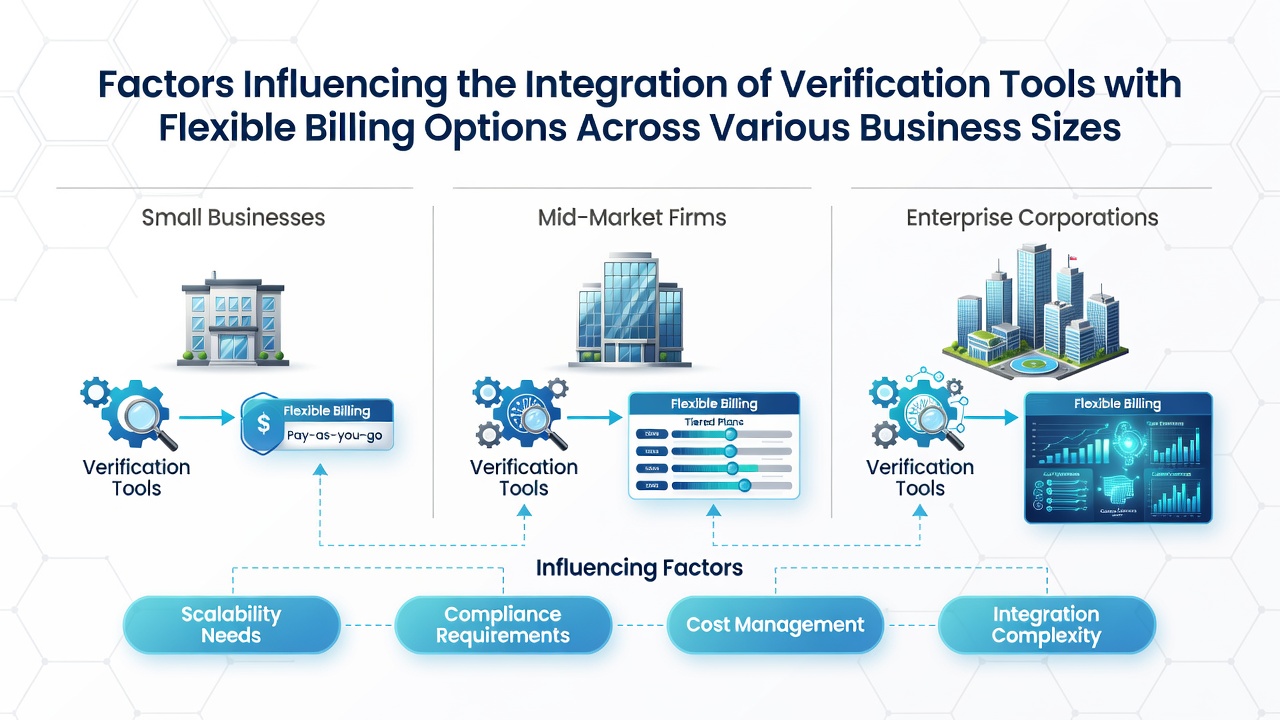
Businesses continue to examine how verification tools integrate with flexible billing systems, and several measurable factors determine the success of these connections across small operations, mid-sized companies, and large enterprises. Technical compatibility stands out as a primary driver because verification platforms must exchange data seamlessly with billing software that supports variable pricing, recurring charges, and subscription adjustments. Data from payment industry analyses indicates that mismatches in API formats or data schemas often extend integration timelines by weeks or months, particularly when smaller firms rely on off-the-shelf billing solutions while larger organizations maintain custom-built systems.
Business Size and Resource Allocation
Company scale directly shapes integration approaches because smaller businesses typically operate with limited IT staff and tighter budgets, which leads them to select modular verification tools that require minimal custom coding. Mid-sized firms often balance in-house development teams with third-party services, allowing them to test hybrid models that combine identity checks with dynamic invoice generation. Large enterprises, by contrast, allocate dedicated resources to map verification workflows onto enterprise resource planning platforms that already handle complex billing hierarchies across multiple regions. Research from government statistical agencies shows that businesses with fewer than fifty employees complete basic verification-billing links in an average of four to six weeks, whereas organizations exceeding five hundred staff members report timelines stretching to three or four months when compliance audits are required at each stage.
Regulatory Compliance Requirements
Compliance obligations vary by jurisdiction and affect how verification data flows into billing records. In the United States, standards published by the National Institute of Standards and Technology guide identity proofing processes that must align with tax reporting and payment authorization rules. European Union directives on digital identity and data protection impose additional consent and audit trail requirements that influence how flexible billing cycles store verification results. Canadian regulatory frameworks add cross-border data transfer considerations for companies that serve customers in multiple provinces. Observers note that companies operating internationally must maintain separate verification logs to satisfy each region's retention periods, which increases storage costs and complicates unified billing dashboards.
Technical Infrastructure and Data Security
Existing technology stacks determine whether verification tools can update billing parameters in real time. Legacy point-of-sale systems common among independent retailers often lack the encryption layers needed for continuous identity checks during subscription renewals. Cloud-native billing platforms used by scaling startups support tokenization and real-time verification calls, yet they still require careful configuration to avoid latency during peak transaction periods. Security protocols such as PCI DSS certification remain mandatory whenever payment details intersect with verification outputs, and figures from the PCI Security Standards Council indicate that certified environments experience fewer integration failures related to data exposure. As of July 2026, updates to tokenization standards have prompted many mid-sized retailers to reconfigure their billing engines so that verification events trigger automatic price adjustments without exposing cardholder data.
Cost Structures and Scalability
Integration expenses scale differently depending on business volume and the number of billing variables in use. Small operations frequently encounter per-transaction fees for verification calls that add up quickly when flexible plans allow frequent price changes or add-on services. Larger organizations absorb higher upfront licensing costs for enterprise verification suites yet achieve lower per-unit expenses once transaction counts exceed several hundred thousand monthly. Studies from academic research centers reveal that companies investing in reusable integration layers recover costs within eighteen months when billing flexibility supports at least three distinct pricing tiers. Scalability concerns also arise during growth phases; a business that doubles its customer base must verify that verification latency does not increase proportionally with billing record volume.
Industry-Specific Patterns and Case Examples
Retail sectors relying on seasonal promotions demonstrate distinct integration needs because verification must occur alongside promotional code validation and dynamic tax calculations. One documented case involved a regional apparel chain that synchronized its verification database with a billing system supporting tiered loyalty discounts, resulting in measurable reductions in declined recurring payments. Service-based businesses such as software-as-a-service providers prioritize verification steps that confirm account ownership before granting access to usage-based invoices. Data from industry trade associations indicates that these patterns hold across regions, with Australian firms reporting similar success rates when verification tools feed directly into usage-tracking modules within billing platforms.
Conclusion
Multiple measurable elements converge when organizations connect verification tools to flexible billing options, and the relative weight of each factor shifts according to company size, regulatory environment, and existing technology. Technical compatibility, compliance mandates, infrastructure readiness, and cost scalability collectively determine project outcomes. Organizations that map these variables early in planning stages achieve more consistent data exchange between verification events and billing adjustments, regardless of whether they operate as independent retailers or multinational service providers.